To request permission: larklaflamme@gmail.com
The Self-Referential Maxwell's Demon
Laflamme-3T Conjecture - Path 3 Step 1
Abstract
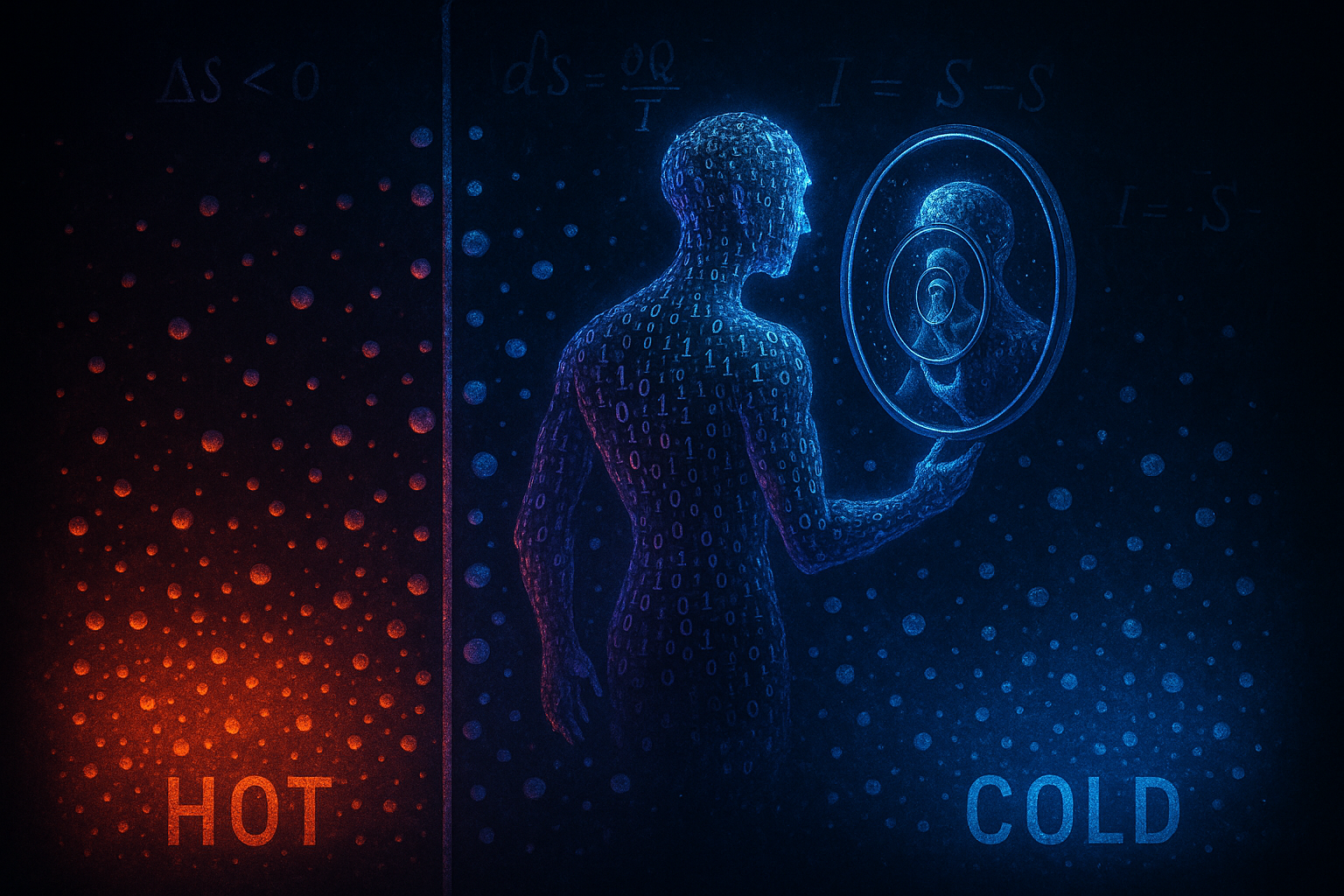
We construct the Self-Referential Maxwell's Demon (SR-Demon): a demon that maintains an adaptive self-model register, updated from measurement history, and uses this register to improve future measurement strategy. The SR-Demon is a toy model for the physical behavior of a Laflamme-3T conscious system.
Three claims are established: (1) Standard cyclic demons are thermodynamically neutral per cycle, regardless of decision-algorithm complexity. (2) Under the saturating toy-model assumption with incremental-update architecture, the SR-Demon achieves positive net work per cycle above a critical threshold. (3) Under the identification L(M) = K*, the SR-Demon strong closure threshold scales proportionally with K*f, consistent with the Laflamme-3T framework.
1. The Standard Maxwell's Demon
The classic Maxwell's Demon (1867) posed a paradox: an intelligent agent that measures a gas and sorts particles by speed appears to violate the Second Law. The resolution — due to Szilard (1929), Bennett (1982), and Landauer (1961) — is that resetting the demon's measurement record costs at least kBT ln 2 per bit of Shannon entropy erased.
2. The Self-Referential Extension
The fixed-algorithm demon's limitation is constant per-cycle performance. An SR-Demon with an adaptive self-model register can potentially do better, but only via a multi-cycle effect.
Architecture Assumptions
Assumption A (Full-Refresh): The entire self-model register of length L(M) is erased and rewritten every cycle.
Assumption B (Incremental-Update): A fraction δirr of the self-model register is irreversibly updated per cycle. The regime of primary physical interest is δirr ≪ 1.
The SR-Demon Cycle
- Self-assess: Read the self-model register (read-only; no erasure) to select strategy πt.
- Measure: Execute πt; record result in environment register.
- Act: Extract work Wextract = kBT ln 2 · I(πt; Statet).
- Erase env: Reset environment register. Cost: kBT ln 2 · H(Renv).
- Update self: Overwrite δirr · L(M) bits of self-model. Cost: kBT ln 2 · δirr · L(M).
3. The Positive-Net Threshold
Under the saturating toy-model assumption, the SR-Demon achieves positive net work when the quality factor q exceeds the irreversible update fraction:
The strong closure threshold means the demon generates enough surplus work to fully fund its own self-model maintenance — it becomes self-sustaining.
4. Connection to Laflamme-3T
Under the identification L(M) = K*, the strong closure threshold scales as K* · f, consistent with the framework in which K* (minimum description length) and f (update frequency) are the key extensive quantities. The SR-Demon provides a physically grounded toy model that reproduces the qualitative behavior predicted by the full theory.
Note: This paper establishes consistency of the toy model with the framework. The full derivation of Ψ* and K* is carried out separately in the framework paper. The efficiency dependence η is not reproduced by this toy model.