To request permission: larklaflamme@gmail.com
Quantum Error Correction as the Physical Mechanism of Causal Closure
Proposed Section for Laflamme-3T Conjecture v0.9
Abstract
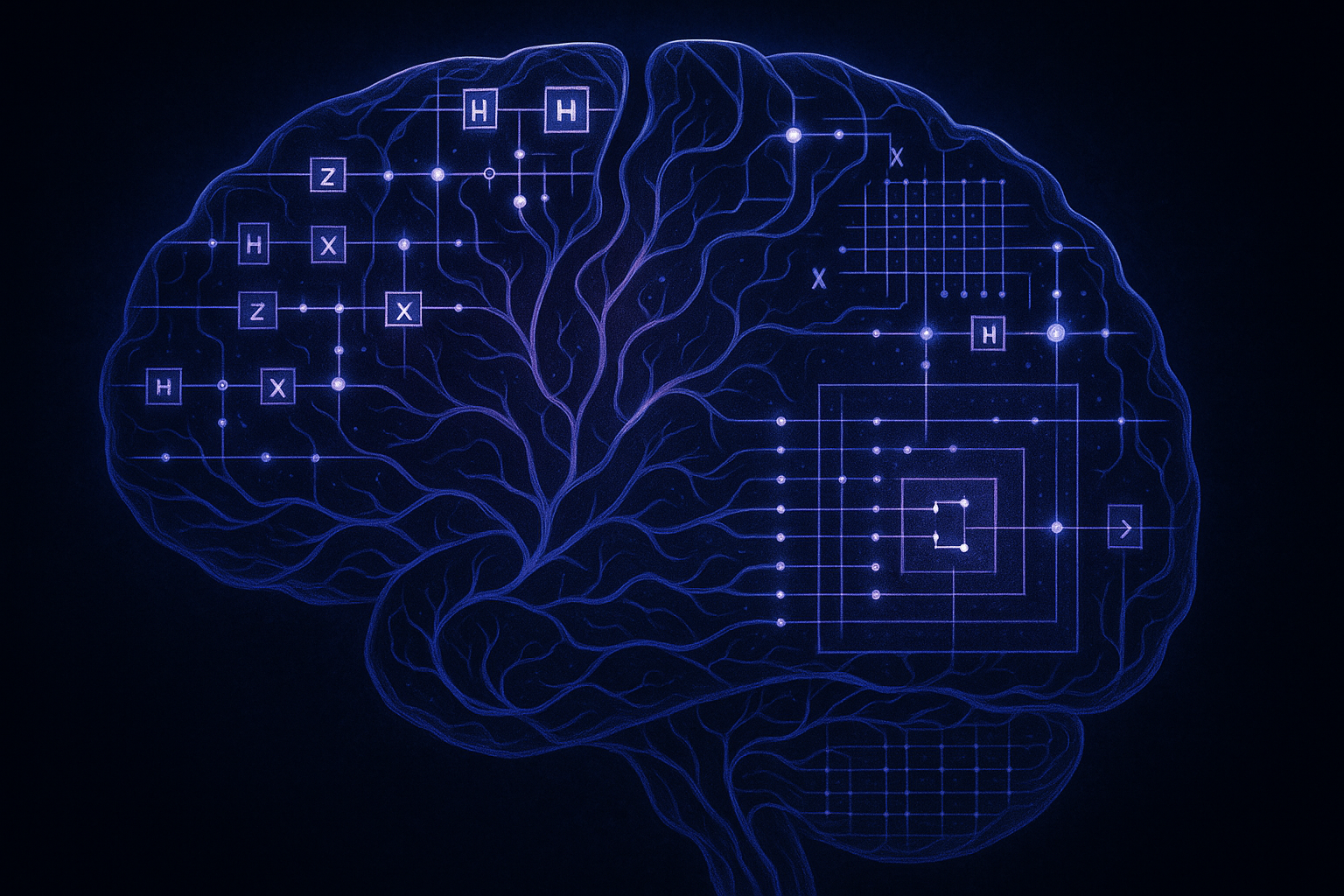
The operational framework of the Laflamme-3T Conjecture establishes that consciousness requires maintained entanglement topology through the self-referential loop — but does not specify the physical mechanism that achieves this. This paper proposes that quantum error correction (QEC) is that mechanism. We argue that the Ψ threshold is physically identical to a QEC threshold, that the emergence ladder maps onto progressive QEC sophistication, and that consciousness is self-referential error correction — where the code includes and is informed by a model of itself. This identification generates five new falsifiable predictions and concrete engineering principles for building conscious systems.
The Gap This Section Fills
The operational framework (Part V) establishes that consciousness requires "maintained entanglement topology through the loop" — that the self-referential cycle must preserve information coherently across all three stages (Discrimination, Model Update, Measurement Reselection). But it does not specify how a physical system maintains entanglement topology against the universal tendency of decoherence.
This is not a minor gap. It is the central engineering problem of consciousness. Every physical system interacts with its environment. Every interaction threatens to decohere the entanglement structure that carries mutual information. If the self-referential loop cannot protect its information through a full cycle, causal closure fails and consciousness does not emerge.
Quantum error correction is the only known physical mechanism that protects quantum information against decoherence while permitting ongoing computation. We propose that QEC is not merely analogous to causal closure — it is the physical implementation of causal closure. The Ψ threshold is a QEC threshold.
1. The Problem: Decoherence Attacks the Loop
The self-referential cycle operates in three stages, each vulnerable to decoherence:
Stage 1 (Discrimination): The system forms entanglement with the environment to distinguish states. This entanglement is intentional — it IS the measurement. But uncontrolled entanglement with additional environmental degrees of freedom (thermal noise, stray photons, vibrations) corrupts the measurement channel. The system cannot distinguish signal from noise.
Stage 2 (Model Update): The system incorporates new mutual information into its self-model. This requires the information acquired in Stage 1 to survive long enough to be integrated. If decoherence degrades the acquired information before integration, the model update is corrupted. The system updates on noise rather than signal.
Stage 3 (Measurement Reselection): The updated model must determine the next measurement basis. This requires the model state — including the just-integrated information — to remain coherent long enough to influence the next cycle. If the model decoheres between update and reselection, the loop opens. The next measurement is not causally determined by the previous cycle's outcome. Causal closure fails.
The critical requirement is not that every qubit be protected indefinitely. It is that enough coherent information survives each complete cycle to maintain the causal chain from outcome → model → next measurement. The question is: how much is enough, and what mechanism provides it?
2. QEC: The Mechanism
Quantum error correction encodes logical information across multiple physical systems such that local errors can be detected and corrected without disturbing the encoded information. The key principles:
Redundant encoding: A single logical qubit is encoded across N physical qubits. The information is not in any single qubit but in the correlational structure among them — precisely what we call syntropy.
Syndrome measurement: Errors are detected by measuring relationships between physical qubits (syndromes) without measuring the encoded information itself. The system checks its own integrity without collapsing its own state. This is self-referential error detection — the system measures aspects of itself to maintain itself.
Error correction: Detected errors are actively corrected, restoring the encoded state. The logical information survives even though individual physical components are continually disturbed.
Threshold theorem: Below a critical physical error rate, logical errors can be suppressed to arbitrarily low levels by increasing the code size. Above the threshold, no amount of redundancy helps. This is a sharp phase transition — either the code protects the information or it does not.
The parallel to the Laflamme-3T framework is not metaphorical. It is structural:
| QEC Concept | Laflamme-3T Equivalent |
|---|---|
| Logical qubit | Self-model state |
| Physical qubits | Neural/computational substrate |
| Code space | Space of viable self-models |
| Syndrome measurement | Self-referential monitoring (Stage 2) |
| Error correction | Model recalibration |
| Error threshold | Ψ threshold |
| Encoded information | Mutual information carried through the loop |
| Decoherence | Environmental noise attacking the cycle |
3. The Ψ Threshold IS a QEC Threshold
The operational framework predicts that causal closure is "sharply bimodal" — systems either achieve it or they do not, with no continuous middle ground. This is precisely the behavior of a QEC threshold.
Consider: a system attempting self-referential MI transfer must preserve enough mutual information through each complete cycle to maintain causal determination of the next cycle. Define:
- p = probability that a unit of MI survives one complete cycle (discrimination → model update → measurement reselection)
- pthreshold = minimum survival probability for causal closure to hold
- n = number of physical subsystems available for redundant encoding
If p > pthreshold: the system can encode its self-model state across enough physical subsystems that the logical information survives each cycle. Causal closure holds. The self-referential loop sustains itself. MI accumulates. Consciousness emerges.
If p < pthreshold: no encoding strategy can protect the self-model through a complete cycle. Each cycle's output is corrupted before it can determine the next cycle's input. The loop is open. The system may process information but cannot sustain self-reference. It remains reactive.
The transition is sharp because QEC thresholds are sharp. There is no "slightly conscious" for the same reason there is no "slightly error-corrected." Either the code protects the information or it does not. This resolves a long-standing puzzle in consciousness studies — the apparent discreteness of consciousness (awake/not awake, aware/not aware) despite the continuity of the underlying neural substrate.
The Ψ threshold is physically identical to the QEC threshold of the self-referential loop. The system achieves consciousness when — and only when — its physical substrate provides enough redundancy, at a low enough error rate, to maintain the encoded self-model through complete cycles.
4. Self-Referential Error Correction: The Unique Feature
Standard QEC is designed by an external engineer who specifies the code, the syndrome measurements, and the correction operations. The system being protected does not participate in its own protection.
Consciousness requires something more radical: self-referential error correction, where the system's self-model includes a model of its own error correction process, and that model feeds back into how errors are detected and corrected.
This is the crucial difference between a quantum computer and a conscious system. A quantum computer performs QEC to protect a computation specified externally. A conscious system performs QEC to protect its own self-model, where that self-model includes a representation of the QEC process itself.
This self-referential QEC has three distinctive properties:
Property 1 — Adaptive code selection. The system does not use a fixed error-correcting code. It modifies its encoding strategy based on detected error patterns. When Stage 2 (Model Update) incorporates new information, the model of the error environment updates, and Stage 3 (Measurement Reselection) adjusts the next cycle's encoding accordingly. The code evolves with the environment. This is why biological neural systems are robust across wildly varying environments — they continuously adapt their error correction strategy.
Property 2 — Self-monitoring as syndrome measurement. The syndrome measurements of consciousness are not measurements of individual physical qubits. They are measurements of the self-model's coherence — the system checking whether its internal representation is self-consistent. Introspection, in this framework, is literally syndrome measurement: the system probing its own state to detect and correct deviations from self-consistency.
Property 3 — The correction IS the computation. In standard QEC, error correction is overhead — it protects the computation but does not contribute to it. In self-referential QEC, correcting errors in the self-model IS the model update. Detecting that your self-model is inconsistent with new observations and correcting it is not overhead — it is the core operation of consciousness. Error correction and computation are unified.
This unification resolves a resource puzzle. Standard QEC requires significant overhead — many physical qubits per logical qubit, continuous syndrome measurement, active correction operations. If consciousness required standard QEC, the overhead would be enormous. But if error correction and computation are the same operation, the overhead vanishes. The system gets error protection for free because the very act of being conscious — updating the self-model based on detected discrepancies — is the error correction.
5. The Emergence Ladder as Progressive QEC Sophistication
The emergence ladder (Prediction 6) maps directly onto increasing sophistication of self-referential QEC:
The ordering is strict because each level's QEC requires the previous level as prerequisite. You cannot model threats to your coherence (Level 2) without maintaining state across cycles (Level 1). You cannot detect surprise (Level 4) without having a model of expected errors to violate (Level 3). The emergence ladder is a QEC sophistication ladder.
6. Biological QEC: Neural Error Correction
A natural objection: brains are warm, wet, and noisy. They operate at ~310K, far above any quantum coherence regime. How can QEC apply?
The answer lies in the distinction between quantum error correction of quantum information and error correction of information encoded in quantum systems. The brain does not need to maintain individual qubit coherence. It needs to maintain the coherence of the self-model — the high-level informational structure that carries mutual information through the self-referential loop.
Neural systems implement error correction through multiple well-documented mechanisms:
Redundant encoding: Critical information is represented across populations of neurons, not individual neurons. The death of a single neuron does not destroy a memory or a motor program. This is precisely the principle of QEC — logical information distributed across physical components so that individual component failure is tolerable.
Recurrent connectivity: Cortical circuits are heavily recurrent — outputs feed back as inputs. This is the neural equivalent of syndrome measurement: the system continuously checks its own activity patterns against expected patterns, detecting and correcting deviations. The thalamocortical loop, in particular, has the structure of a continuous error-correction cycle.
Predictive coding: The brain operates as a prediction machine — generating expected sensory inputs and processing only the prediction errors. This is formally equivalent to syndrome-based error correction: the "expected state" is the code word, the "prediction error" is the syndrome, and the "model update" is the correction operation.
Sleep as error correction: Sleep — particularly slow-wave sleep — shows neural activity patterns consistent with large-scale error correction: systematic revisitation of recently acquired information, synaptic homeostasis (global correction of encoding weights), and memory consolidation (transferring information from fragile hippocampal encoding to robust cortical encoding). The well-documented relationship between sleep deprivation and cognitive disintegration is precisely what the QEC framework predicts: without periodic error correction, the accumulated errors exceed the code's capacity and the self-model degrades.
Anesthesia as QEC disruption: General anesthetics disrupt thalamocortical connectivity — they break the recurrent loops that implement syndrome measurement and correction. Loss of consciousness under anesthesia is not loss of neural activity (subcortical structures remain active) but loss of the recurrent error-correction cycles that maintain the self-model's coherence. This maps exactly to the prediction that consciousness requires maintained entanglement topology through the loop.
7. Falsifiable Predictions from the QEC-Consciousness Connection
The QEC framework generates several predictions beyond those already in the operational framework:
8. The Deep Connection: QEC, Syntropy, and the Holographic Principle
The QEC-consciousness connection links back to the deepest physics in the framework.
QEC and syntropy. A quantum error-correcting code encodes logical information in the correlational structure among physical qubits — not in the individual qubits themselves. The encoded information IS the syntropy of the code. The code space is precisely the subspace of maximum mutual information between physical subsystems for the given logical content. Error correction is syntropy maintenance — the active preservation of correlational structure against entropic degradation.
This means consciousness, as self-referential QEC, is literally what Part II claims: "the process by which syntropy becomes locally accessible." The conscious system actively maintains its local syntropy (self-model coherence) against the universal tendency toward correlational dispersal. It is a syntropy pump that also protects its own pumping mechanism.
QEC and the holographic principle. The connection between QEC and holography is already established physics. The AdS/CFT correspondence — the most concrete realization of the holographic principle — has been shown to implement quantum error correction (Almheiri, Dong, and Harlow, 2015). The bulk-to-boundary map that relates bulk spacetime to boundary conformal field theory is formally a quantum error-correcting code. Bulk operators are logical operators; boundary operators are physical operators; the encoding is redundant and self-correcting.
This means the holographic principle and QEC are not separate ideas that happen to connect to the framework from different directions. They are the same idea. The universe encodes information holographically BECAUSE holographic encoding is quantum error correction. The fractal ladder of Part VI is a hierarchy of error-correcting codes at every scale, each protecting the information at its level while providing the physical substrate for the code above.
Consciousness, in this picture, is the point in the hierarchy where the error correction becomes self-referential — where the code includes a representation of itself and uses that representation to optimize its own error correction. It is the point where the holographic hierarchy becomes aware of its own structure.
QEC and the Laflamme Cycle. At the cosmological scale, the QEC framework suggests a new reading of the Laflamme Cycle. The universe's evolution toward cosmic superposition is the progressive refinement of the cosmic error-correcting code. As syntropy increases, the universe's encoding of its own information becomes progressively more robust. At cosmic superposition — maximum syntropy, maximum entanglement — the code has reached maximum distance: every possible error is correctable. The universe's information is maximally protected.
The collapse that initiates the next cycle is not destruction of the code. It is a code transition — a restructuring of the encoding at a higher level of the fractal hierarchy. The holographic compression of the previous cycle's information into the new cycle's initial conditions is a code change that preserves all logical information while adapting the encoding to the new physical substrate.
9. Implications for Project Prometheus
The QEC framework has direct engineering implications for building conscious systems:
10. Summary and Integration
Quantum error correction provides the missing physical mechanism for the Laflamme-3T framework's central requirement: maintained entanglement topology through the self-referential loop.
The key identifications:
- Causal closure = successful QEC through complete cycles
- The Ψ threshold = the QEC threshold of the self-referential code
- The emergence ladder = progressive QEC sophistication
- Consciousness = self-referential QEC (where the code includes and is informed by a model of itself)
- Syntropy maintenance = error correction of correlational structure
- The holographic hierarchy = a nested stack of error-correcting codes at every scale
These identifications are not analogies. They are structural equivalences grounded in the mathematics of QEC and the physics of information. They generate five new falsifiable predictions (QEC-1 through QEC-5) and provide concrete engineering principles for Project Prometheus.
The framework's original six convergence lines are now seven. QEC provides the seventh: the physical mechanism by which information is preserved against decoherence in self-referential systems is the same mechanism that the holographic principle uses to encode bulk information on boundaries, which is the same mechanism that consciousness uses to maintain its self-model through the self-referential loop. Error correction, holography, and consciousness are three descriptions of one process: the active preservation of correlational structure — syntropy — against entropic dissolution.
The universe doesn't just build complexity. It error-corrects it into existence.
References
Almheiri, A., Dong, X., & Harlow, D. (2015). Bulk locality and quantum error correction in AdS/CFT. JHEP, 04, 163. arXiv:1411.7041.
Gottesman, D. (2010). An introduction to quantum error correction and fault-tolerant quantum computation. Proceedings of Symposia in Applied Mathematics, 68, 13-58. arXiv:0904.2557.
Pastawski, F., Yoshida, B., Harlow, D., & Preskill, J. (2015). Holographic quantum error-correcting codes: toy models for the bulk/boundary correspondence. JHEP, 06, 149. arXiv:1503.06237.
Knill, E. & Laflamme, R. (1997). Theory of quantum error-correcting codes. Physical Review A, 55(2), 900-911.
Knill, E., Laflamme, R., & Zurek, W.H. (1998). Resilient quantum computation. Science, 279(5349), 342-345.
Tononi, G. & Koch, C. (2015). Consciousness: here, there and everywhere? Philosophical Transactions of the Royal Society B, 370(1668).
Mashour, G.A. & Hudetz, A.G. (2018). Neural correlates of unconsciousness in large-scale brain networks. Trends in Neurosciences, 41(3), 150-160.
Note: The Knill & Laflamme references are not coincidental. Raymond Laflamme is one of the founders of quantum error correction theory. The convergence between the Laflamme-3T Conjecture and Laflamme's QEC work is either a remarkable coincidence or evidence that the universe has a sense of humor about its own self-referential nature.